Showing posts with label sustainability. Show all posts

Monday, August 31, 2009

Northeast Tomato Tragedy of 2009

My idea of sensory perfection:

I am slowly wandering barefoot through a vast, wild garden, when I stumble across some bandit cherry tomatoes. A warm breeze wafts the earthy aroma of the tomato plants. I pick a defiant little fruit and pop it into my mouth; it is warm from the hot sun. It bursts between my teeth. Delightful! Gently, a cool rain creeps in, releasing nutrients from dirt into the mist. I inhale the air of life living.


Nothing smells quite like a tomato plant. Anyone who has grown tomatoes just knows what I mean. Right now, we should be bombarded with tomatoes in the Northeast, they should be popping out of garbage cans and tires and anything else deemed to be an effective plant container. We should be eating them like apples with sea salt, with the freshest mozzarella, in pastas and sauces, canning them for bleak winter, they should be coming out of our ears!


2009 has not been kind to the tomato. Here in the Northeast, late blight and a wet summer has left our tomatoes with soggy bottoms and gray fungus. Boooooo!


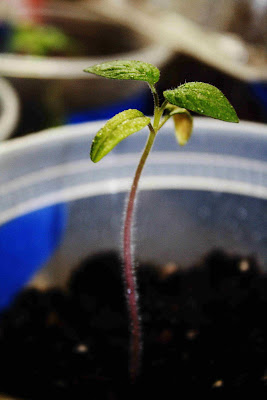
I grew my tomatoes from seed this year. I started them in March, that mercurial lamb-beast of a month, in the windowsill of my Washington Heights apartment. In the beginning, the best way to describe them would be "dinky." They were runts, city kids, compared to their hearty, country-grown cousins. Walmart, the root of the insidious late blight and all evils, sold infected plants more than triple the size of my plants to their uninformed customers! You see, people want plants, but they don't want to care for plants. Give 'em a genetically-modified, almost-mature tomato plant so they'll see progress immediately, feel that they've done something important, when in reality that plant already spent 75% of its life in some scary Walmart greenhouse being cared for by exploited workers with massive amounts of pesticides. Mmm, tasty.

Well, the opposite of that is this: my homegrown heirlooms with olive oil, torn basil and salt in the very window of their early lives! Look how far they've come!

Simply amazing.

Monday, August 3, 2009

Sustainability: A Promise and A Confession

In Ma Nature's book, August is a superstar. She's pregnant with potential. Her drought-loving ways force juicy tomatoes out of the earth. Cucumbers explode with abandon, insouciant and oblivious to their imposing presence like teenagers on the subway. All of a sudden our peaches are no longer from South Carolina, but from towns closer to home. Inconspicuous, dense cantaloupes hide from the sun beneath expansively shady, ankle-deep leaf canopies and begin to sweeten, secretly. Summer squash, who sauntered onto the scene last month, seem to spring out of the soil with certainty.
Corn. Pears. Watermelon. Summer honey. Blueberries. It is easy to eat locally in August, and there's really no reason we shouldn't be frequenting our local farmers' markets (or, if you're lucky like me, urban farms,) every possible day.
We must celebrate nature's bounty and eat, for soon it will be winter and we'll subsist on tough-skinned squash and root veggies, canned summer memories supplementing-- if we're lucky (and motivated enough to can the millions of tomatoes that will ripen before we know it)-- our bland yet reliable winter produce.
It is the month of tanginess. Of sweet, slimy, and satisfying. The Juicy Month. So why am I ordering good old George's calzone again?
1. I live in Washington Heights.
a) Most of the produce in the bodegas is from Mexico or Florida, two of the worst places for human rights violations in the food system. After reading about the modern day slavery of the tomato pickers, I can't, in good conscience, purchase a Mexican or Floridian tomato. Since knowledge is power, you cannot, in good conscience, ignore that link.
b) Yes, I could've taken the train down to the Greenmarket today. But in my lazy world, could've=didn't.
c) George's Pizza is reliably delicious, cheap, and easy. His calzones are a lactose- intolerant person's worst nightmare, and, conversely, a cheese-lover's fantasy. He's been in business since what seems like the Civil War and is no joke.
2. I have become incredibly lazy on my days off.
a) Working in the sun all week is tiring. Plus, I'm half Irish and need a break from all that Vitamin D.
b) I am attempting to "be" a writer: I hole up all day in my apartment and convince myself I am incapable of leaving, then start to believe it.

Apparently, I am eating my fruits and veggies, because fruit flies have taken over my entire apartment. The culprit is our compost bin. Or perhaps it is more apt to write "compost" bin. We abandoned all attempts to compost when I opened it one morning and was pelted with steroid-sized fruit flies. I was so terrified I closed it and haven't gone back since. They're huge! They've been living in the very thing that sustains them: sweet, dark, rotting dankness.
The roid-sized fruit flies remain in the "compost" bin, which we might choose to call the "rot" bin for accuracy's sake. Meanwhile, their smaller relatives, deprived of sugar and desperate, hide in my coffee grinds and burst forth into my nostrils and eyes as soon as the filter door swings open. They bite. They make me itchy just thinking about them.

I have no idea what to do with the box, other than throw the entire thing away, which seems like a waste, but what are the options? I thought of dumping it out on the street late at night, right before street cleaning, but Frank objected to this idea citing our local homeless man and the capabilities of the street cleaning machine.

I know what I have to do: I have to empty it into a garbage bag, outside, at night. I have to get it all in there. Then I have to tie the bag. I will proceed to... take the bin to the bathroom to wash it out in my shower? This seems unnecessarily gross. But I can't think of what to do! I'm not a city kid! (Any suggestions from city kids, who may or may not have dealt with a similar problem, would be greatly appreciated.)

I'm scared. Of the flies. Of the methane. Of the rot. I did it all wrong and now I have to pay.

After I eat my calzone, I promise to eat fresh fruits and veggies from the farm for as many meals as possible. I figure this counts as penance for my failed compost endeavor, in the eyes of the Sustainability Gods.
Apparently, sustainability is a concept shared by humans and fruit flies alike. One being's trash is another being's treasure.

Tuesday, July 21, 2009

Sustainable Weekend

A sustainable weekend looks like this:

1. Friday night farm dinner, eaten with "stranger." All produce picked in Red Hook only hours earlier.
a. Massaged kale (spoken in child-molester-voice)
b. Fresh cukes with garlic-basil yogurt sauce
c. Collards and black eyed peas
d. Red Stripe
e. Greens

2. Saturday Farmer's Market in Red Hook
a. Purple kale and Hakeuri turnips
b. Ruby Chard, aka Eliza Chard:
c. non-Funyon onions. (Funyons are on my top-10 Grossest Foods list because they smell like feet, feel like like eczema, sound like styrofoam, etc.)
3. Free reggae Concert in Central Park on Sunday:
a. Play with last night's pinata winnings! Don't let these chotchkies go to waste!
1. Pretend they are members of your army, fighting to save the planet!
2. Imagine what it would be like to fall in love with a small yellow soldier.
3. Marvel at the self-restraint you've demonstrated in withstanding the urge to pull the parachute's string. (2 days and counting!)
b. Watch the happy people enjoying a free summer concert.
c. Get inspired to dig around Craigslist for size 8.5 roller skates!
d. Pump Up The Jam:
4. Ruminate about American consumerism:
5. Don't let the rain get you down! Instead, set up still lives involving reusable milk cartons, fresh produce, and antique books!


Thursday, May 21, 2009

Honey Dreams


Although beekeeping is the main subject around which all posts (tangentially) gather, this blog also aims to document my shift (and that of my friends) toward a more sustainable life.

Nowadays, the idea of sustainability is inextricably linked to environmentalism. For some strange reason, however, I've always been more compelled by the concept of sustainability than that of environmentalism. Sustainability seems to speak to the human aspect of environmentalism by appealing to our inherent selfishness: how do we benefit, as opposed to the Earth? Because let's face it, many people (especially people in 1st world countries) don't see the connection between the Earth's health and our own.

Environmentalism sounds hard. It conjures images of lugging out the recycling and the garbage. It implies more work. What is so incredibly pathetic about this perspective is that the "work," in reality, involves thought more than physical labor. But people, and I'm talking about us 'Mericans, don't like to think. The mere consideration of the possible material of an empty container of yogurt proves to be too taxing for certain individuals. "As a tax paying 'Merican, I've got the right to throw this here yogurt container wherever I see fit." It is almost as if we feel entitled to not think. (And by "we," I mean "they." However, I am attempting to avoid "they" statements, as I do not want to define "them.")

Society has taught us that if we need something, we should buy it. But what if we don't want to buy it, or can't buy it, as is becoming the case for more and more people? Instead of looking around and asking oneself, "How can use what I already have to get what I want?" most people will either wait until they can buy it, or decide they don't need it, after all. But we're more creative than that...

I have always had a visual image of my "ideal life" in my mind. This image has drastically changed throughout the years, and continues to tweak itself as time rolls out. It probably changes imperceptibly from second to second. Today, my ideal life involves bees, obviously; lots of all different types of hives all over property that I own. This same property will be home to many fruit trees and and vegetable gardens with tons of herbs, a pumpkin/melon patch, an expanse of wildflowers that morphs into its own conception of "beautiful." On the property, there will be an old house that needs a lot of work done. I'll live there with my true love, and we'll spend our days fixing the house, attending to our gardens and hives, providing fresh produce to our community, and trading what we have for what we don't have. Building the life that we want with our hands, essentially; self-sufficient and self-employed. The house will be filled books, laughter, and dogs. We'll grow our own indulgences, and invite friends and family to cook and/or enjoy them with us.

I could go on, but I'm realizing that the more detailed I get, the more I remove myself from society, and the more unrealistic my "ideal life" becomes. (It snowballs into commune territory.) And I'm not trying to make this unrealistic or unreachable: I am convinced, today, that this life is completely viable, and it is up to me to make the choices that will get me there.
The new bees, that will reside in my parents' backyard in Connecticut, will produce honey that I intend to sell. This will be my first entrepreneurial endeavor of any kind, except for the odd lemonade stand and the "Babysitters Club" I formed with 5 other girls one summer, inspired by the book series of the same title. (I was Claudia, the artistic, popular, half-Asian fashion plate who hid candy in fake books and dealt with her grandmother Mimi's stroke in the 7th book of the series, Claudia and Mean Janine.)

It is my first foray into semi self-employment, the initial step in what I hope will be a lifelong journey. I want to be judged on my product rather than my personality, whether the product is the honey from my bees or my words themselves. This first year will be more of an experiment than anything, since I'm learning absolutely everything as I go. It is exciting, strange, and unexpected. The unexpectedness makes it slightly intimidating, but I figure, what do I have to lose? Following this line of reasoning, I have also decided to pickle and sell my cukes this year, whose abundance last summer was overwhelming. (It was possible to subsist on cucumber soup* alone for a period of about 2 weeks.)

*Cukes, plain yogurt, mint, scallions, chicken broth, fresh garlic for spice, blended til smooth, chilled, with salt and pepper to taste. The most satisfying food/drink on a hot, humid day in July. Best when consumed outdoors, preferably near pool and/or beach.

Anyway, instead of buying jars to bottle these things, I want to use existing jars. Why buy new jars when I've got, you've got, we've got old jars right here? How much energy does it take to melt that glass into a different-looking jar?

A sweet, sweet reverie...

...honey housed in all different shapes and sizes of recycled jars and bottles, labeled by hand with little flowers drawn all over, maybe a recipe tag for something outrageous like honey milkshakes; each bottle unique; I'm dreaming up names: C's Bees'? Sweet C Honeybee? Strange varieties of pickled cucumber, like round, yellow, Lemon Cukes and heirloom White Wonders in spatial and tactile disharmony, each one distinct but strangely similar; yellow, green, brine and vinegar and garlic...

The sight of these things existing in reality would give me great pleasure. Photo shoot-worthy. Hopefully the future will unroll in such a fashion that my visions will materialize. If they do, or if they don't, at least I'll be writing about it.

Save the jars and bottles that you can imagine housing our future honey and/or pickles, if you'd like to contribute to this honey/pickle/heirloom tomato* venture. Of course, you know who you are.

*I have over 15 healthy-looking Cherokee Purple tomato plants that I grew from seed in my apartment. This weekend, they'll be making the move outdoors, to the quiet sanctuary of my parents' backyard (with the new bees!) Perhaps a small stand in a Farmer's Market? I think so.

On another sustainability note, its composting time! Now that the summertime bounty is beginning to crowd produce isles everywhere, we've decided to start a worm farm up here at the homestead in Wash Heights. You can buy worms (and compost) at the Greenmarket at the Community Compost:

They sell a "worm condo" to house the worms, but we're just using an old plastic box for storing clothes and stuff. Anything with a top that you can poke holes in is fine. It you're a gardener (or know one!) there's no reason you shouldn't compost: its easy, cheap, and natural. nyccompost.org has great info. You can even bring your food scraps to places in your hood where someone is composting, even if you don't want to. Seriously, people want your food scraps badly.

There are tons of gorgeous herbs and tomato plants for sale right now... both of which grow well in containers if you're in the city (and have enough sun.) For those of you who have had the misfortune of never smelling the fresh, earthy scent of a healthy tomato plant, RUN to the nearest farmer's market and at LEAST stick your nose into its depths and inhale with gusto; even better to buy one and savor its scent, admire its stature, and devour its fruit all summer long.

Now is the time, you would-be, could-be gardeners: Make something grow!

Wednesday, April 29, 2009

Bee Tea

We headed over to Roberta's to make the bee tea. I hadn't been there since the raised beds were built atop the container. I'm consistently impressed by the amount of planning, old-fashioned manual labor, and enthusiastic volunteerism that the Brooklyn Avant Gardeners bring to the table. It is truly rare for a group of young people to say "Let's do this" and then actually do it. AND not just do it half-assed, but do it completely and with passion. The Bee Team is just one part of what can only be described as a movement, or at least an experiment to see just how sustainable we can be in this crazy city. The answer seems to be: very.

Our carbon footprints are becoming smaller and smaller...
(Disclaimer: this is not an actual "carbon footprint." Rather, it is Meatball's paw print on the container stairs after playing in the raised beds.)

This is how to make Bee Tea:

Step 1: Get a big pot of hot water. Think of it as a gigantic teacup.

Step 2: Add 1 part sugar for each part water, stir, and throw in chosen bee potion herbs.
(The green stuff is stinging nettle... growing at Roberta's! The stars are aligned.)

Step 3: Let steep, then separate herbs from water and ladle into mason jars.

Step 4: Add a few drops of thyme oil. Not too much, this stuff is potent.

Step 5: Taste the tea to make sure it is something you would drink. If not, make modifications so that it is pleasing to your taste buds. Close the lids and let them cool overnight so the sugar is completely dissolved.

(Optional Step 6: Marvel over how pretty the mason jars look in the light:)

We will poke tiny holes in the top of the mason jars. This way, when the bees arrive from Georgia, they won't have to immediately go forage for food. It's the same concept as providing exhausted travelers (especially those unlucky victims of cancelled flights) with a Ruby Tuesdays at the airport hotel, except that the bee food is delicious and nutritious.

I've been so focused on bee matters that I've missed some of the most grueling work days on the gardening side of things. It was great to see the fruits of the Avant Gardeners' labor:

Brandywine tomato plant, still a cute little toddler.


Broccoli! (I'd never guess unless someone told me.)