Showing posts with label Ft. Tryon. Show all posts

Monday, December 21, 2009

Winter Wonderland

My 29th birthday began with a snowball to the face. In a good way.


I worked on perfecting my snow angels.


I've always been bothered by their disco pants. Shouldn't they be in gowns?


Maybe I should start from the middle and move outward, then lift and repeat. It would compromise the traditional form, but the result might prove more aesthetically pleasing.


Might I revolutionize the snow angel??

Tuesday, October 27, 2009

Death of a Bumblebee


If you are a bumblebee, you can die two ways. Unlike the mid-level employee who dies at his desk and no one notices for days, dying mid-work is considered graceful in bumblebee world. A worker bee ceaselessly extracts nectar until she reaches the flower upon which her tired body will rest. When I came across this dead bumblebee in the Heather Garden at Fort Tryon, I wanted to cry. So sad, so poignant, so serene.


However, some bumblebees don't have the work ethic to die with grace. Instead, they are beaten to death by their sisters when deemed a waste of space in a space-limited hive. This raggedy drone's corpse tells of a death much more grisly than that of the worker. His fuzz has become matted and his appendages are akimbo. As they say, Ma Nature giveth and taketh away.


In Virginia Woolf's bleak but beautiful essay The Death of the Moth, she pities the insignificance of the death, and thus the life, of a single dusty-winged insect. Am I wrong, though, or do the deaths of these striped buzzers seem meaningful in some important way? They deserve weighty tombstones or bronzed statues.


Oh autumn, you're breakin' my heart. First, on a blue-skied, rusty-treed Sunday, you take my dog. You continue to expose me to various forms of loss, namely and most notably my drones, my immune system, and my summertime jubilation.


Then, you fleetingly flash your outrageous beauty right in my face, and leave me to fend off rain in the safety of my way-uptown apartment, all alone but for the fruit flies occupying my compost and beyond.


All of this tells me that I'm going to need a pretty radical Halloween costume. I've got a fever and the only cure is ridiculous clothing. The problem is, my imagination is as stunted as my wallet, which is as stunted as a six-year-old chain-smoker.

But I digress...

These autumn colors are the finale in a long celebration of life. Before we know it, it'll start all over again.


Make sure you don't miss it.

Sunday, August 30, 2009

Summer Is Not Over.


Summer isn't over! Yes, I'm wearing more clothes at this very moment than a rugged mountain man might wear in mid-October in Montana. (Remember socks?!? They're so April 2009!) A farmer at Added Value expressed to me that summer was already far behind him, a piece of fluff in a dryer vent. (Like compost, I amended and ameliorated that last part.) I disagree, vehemently! I present you with cold, hard, proof that summer is not over yet.

Exhibit A: The Calendar. Summer does not officially end until September 22. This should be enough to convince the reader that I am right and the farmer is dead wrong. Nonetheless, the following points serve to illuminate summery season signifiers from the LAST TWO WEEKS. Does this look like autumn to you?

  • I didn't think so. This is what sunset looks like in summer: golden glow. The sun's heading down, but against her will. She wants to stay and play, so she lingers for as long as possible.
  • This is me teaching teenagers about honeybees, surprised by how competent I sound on the subject. Do you see a classroom? No. Because its summer vacation.


Some responses from teens:
-To the drone's loss of genitalia and life when he mates with the queen: "Yo, why she gotta do that?"
-In response to the honey-tasting portion of the lesson: "I'm gonna get diabetes from this."
-To the fact that the worker bees, the majority of the hive, are all female: "That's sexist!"
-Student: "Is this a picture of you as a little girl?" Me: "No, that's a picture of me from March."


  • My original intention was to find out the name of this flower and it's growing season to prove that it is still summer. However, technology has, once again, failed to live up to my genius ideas, and there exists no contraption wherefore to download this photo into a flower database and retrieve its common name.

I like to know the names of things, which is why I have been compiling my own flower database of sorts, that will go up once I identify some of the tricky ones with my team of experts. (My dad.) Once I find out the name I will revise this post and thus strengthen my argument! Wha-ha-ha-ha!

  • Picnics. Need I say more?

Yes, you say? Fine. Would an elderly painter set up shop outside if there were the chance of catching a chill? I think not.


Whoa, elderly painter 1-2 punch!

  • This delectable nectarine, sweet with tangy juices, was grown locally. Booyah.

I think I've made my point loud and clear: don't believe the farmer when he tells you summer is dead and gone. Let's not mourn just yet. We've still got some fire in us, don't we? 'Cause if being pumped and rearing to go is wrong, I don't wanna be right!


I've decided to form a team called Summerbusters, made up of highly skilled funsultants with can-do spirits. Don't you want to be somebody's funhero in these waning days of summer? (Funshero if you're a girl.) Delivering 100% pure fun to whomever is lucky enough to hang out with us, bustin' out the funglasses like it's nobody's biznass, you know, normal funsultant work. (Contact me for an application.)

Tuesday, June 30, 2009

Finding Country in the City

For all you haters who think NYC is a dirty, crowded, concrete jungle, meet northern Manhattan. During a long walk through Ft. Tryon, along the Hudson to the northern tip of the island, we discovered this magical oasis called Inwood Hill Park. Every single photograph depicts Manhattan proper.

Here, we have a common Hobbit Hole, certainly home to some sort of wild creature. I contemplated a more intimate exploration before remembering that certain creatures (like groundhogs) can be surprisingly menacing when they suddenly emerge from hiding, as if they were watching you all along.

In this photograph, Frank expresses amused annoyance at his prominence in my photo montage. Note the giant rocks and lush greenery.

Lions and tigers and bears, OH MY! Some parts of this trail were downright creepy! I half-expected to be pelted with apples by the sinister-looking trees themselves!

Abandoned fire hydrant, covered in rusted graffiti, alludes to times of yore when drug dealers and hobos ruled this pristine area. If I were an 80's crack dealer, I'd find Inwood Hill Park quite agreeable in terms of stealth and tranquility.

A felled giant in the woods makes Frank's rugby physique look quite dainty! Can you spot The Frank??

Possibly the most exciting find of the afternoon: a fire pit complete with seating area and scenery comparable to that of the rocky Catskills. A rock shaped exactly like a rabbit refused to be photographed clearly, suggesting supernatural powers and/or rock electromagnetism. Stay tuned for summer party invite.

Ah, finally a reminder that we are, in fact, in the greatest city in the world:

The lack of strangers in these photographs is no coincidence: we spent hours exploring the hilly terrain without encountering a single human bean. Or being. All you Brooklyn folks: take the A Train to 190th and wander in a northeasterly fashion. I mean it!

We made it to the tail end of the Inwood Farmers' Market, just in time to get some local wildflower honey, (light, slightly tart,) buckwheat honey, (dark, slightly bitter,) plus a bunch of apples. While I collapsed into a well-deserved nap at home, Baker Frank whipped up a delightful apple crisp using the freshest of ingredients. I ate half before realizing I should photograph it... Below are Frank's (vague) directions. I highly recommend picking up some buckwheat honey from your local farmer's market and making this decadent treat for someone you love:

Frank's Fantastic Buckwheat Honey Apple Crisp

Skin and core a bunch of apples. Use about 8 different types of apples of varying size.
Soften apples with heat and butter until they are warm. Use a whole stick of butter.
Mush them with potato masher.
Add spices to taste, like cinnamon and allspice.
Add buckwheat honey to taste.
Throw contents into something that you would cook a crisp with.

Crisp part:
1 stick of butter
1/2 cup brown sugar
3/4 cups oats
Slowly add up to a cup of flour, until there is cohesion. "Crumbly and no longer wet."
Sprinkle over mushed apples to cover them completely.

Bake at 350 until until "crisp" forms. (Approx. 30-35 min.)

Let cool and enjoy!

Sunday, June 28, 2009

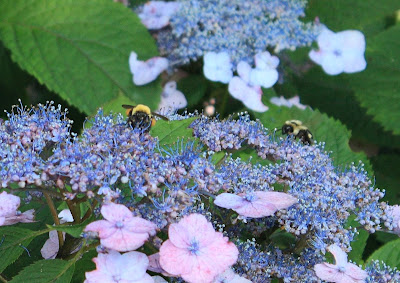
Pollinators Unite in Hydrangea Indulgence

The rain may have taken a toll on our collective morale here in Northeast, but a weekend walk through the wilds of northwestern Manhattan convinced me that Ma Nature didn't mind the wet weather too much. It is incredible how the landscape of Fort Tryon has changed. The skies have (hopefully) cleared, revealing lush landscapes and burgeoning new blossoms. The pollinators, like us humans, seem elated at summer's belated glory in the park's unbelievably lovely Heather Garden. Below, two adorable bumblebees indulge in the sweet nectar of what seems to be wild hydrangea.


Honeybees, too, get in on the action. Note the pollen pants:


More pants! These girls are working hard!


The bumblebee (called "humblebee" in England... how quaint!) works alongside the honeybee in pollinating endeavors; this weekend, the hydrangeas seemed particularly appealing to both types of buzzers.

The complex relationships that exist in nature are innumerable. The bumblebee, however, happens to star in one of the most famous Darwinian examples of unlikely correlations: more bumblebees=more cats(!) The equation goes like this:

Bumblebees have long tongues. (Imagine a straw, rather than a human tongue.) Plus, they are fat. Their heft enables them to wiggle into the prudish red clover, while their long tongues extract the blossom's nectar.

The amount of red clover in an area depends on the number of bumblebees. Honeybees cannot pollinate red clover, as their bodies are not conducive to its shape, and their tongues are too short.

A favorite dish of the field mouse happens to be bumblebee comb, so the more bumblebee comb, the more field mice.

Feral cats love a good field mouse dinner, so where there are field mice, there are also cats.

To explicate summarily: Red clover depends on bumblebee pollination to survive, so where there is red clover, there are bumblebees; where there is bumblebee comb there are field mice, and where there are field mice, there are cats. Whoa!


I'm relieved to see that our city bees haven't starved to death because of the massive amounts of rain. Of course, my concern gives them little credit; they've been doing their thing for much longer than I've been doing mine. Still, the buzzing hydrangea shrubs ensure me, novice beekeeper and mere human, that Ma Nature knows what she's doing.

Tuesday, May 19, 2009

Cuckoo Bumblebees

Fort Tryon Park was abuzz with bumblebees today. I was lucky enough to catch this one on my camera. Look how adorable she is! She hovered noisily, then dipped down and squeezed her fat little self into a flower, gobbled up the nectar and pollen voraciously, then buzzed out, wiggled into another flower, and so on. When I realized that I didn't know much about bumblebees other than their cute factor, I figured this is information that a burgeoning beekeeper should know.

First of all, I thought they didn't sting. I realize now that I based this belief on my experience petting bumblebees, which is extensive (albeit extraordinary.) But they do sting, especially when they're defending their nest. The main difference between of bumblebees and honeybees is colony size; bumblebees usually have less than 50 members per colony, and we've all seen how many honeybees there can be. Plus, all except specially-created queens die before winter. The overwintering queens emerge in the spring and lay eggs conceived with the previous generation's drones. Honeybees, like humans, are forced to deal with the winter by mostly staying inside, eating, and cuddling together.
Bumblebees are skilled pollinators with funny names and cute little fuzzy stripes, so I love them too. Look at that gorgeous poppy pollen.... yum.Interestingly, there is a parasitic species of bumblebee called the Cuckoo bumblebee, who has lost the ability to collect pollen and thus support him/herself. There is no Queen Cuckoo. A female Cuckoo bumblebee will act like a normal bumblebee, foraging nectar and returning to the nest of the normal bees, an invader and impostor. Then, she enslaves the normal bumblebee queen and her entire colony, reproduces, and feeds the normal bees to her young. The Cuckoo Bumblebees have bigger sacks of venom and bigger mandibles, so there's really no defending yourself against the Cuckoos, if you're a bumblebee. The Cuckoo is the baddest bitch in the blossoms. Personally, I find it suspect that for the first few days of her insidious takeover plan, she feeds directly from the flowers. I mean, if she really wanted to she could just continue this practice, rather than brainwashing a bunch of other bees to do all her work for her and then eating them. It just seems a little over the top. For those of you who worry that my irreverently public insults about the Cuckoos will incite some kind of Cuckoo Assassination Mission against me, (and you know who you are,) don't worry. They are totally oblivious to humans and other mammals. Plus, I doubt they'd read a honeybee blog over a bumblebee blog, so I'm 90% safe.
Next time you see a cute little bumblebee waddling into a flower, ask yourself: Could this bee be Cuckoo? Or, could it be the slave bee of a Cuckoo master?
Although you can't see my shoes in the picture below, all of these photos were taken in bee camo. I could say that I didn't even realize it, but that'd be a lie. I did. What can I say? Bees make me happy.

Wednesday, April 29, 2009

The Unbearable Lightness of BEEing

Our bees won't make it up to Ft. Tryon; too far. (We've talked about tagging their tiny legs to track them, but it seemed too time consuming. Thoughts from anyone who has tagged the tiny legs of 5 lbs. of bees??) However, I did see some fantastic specimens of the honeybee sort gathering nectar from the myriad of colorful flora in the lovely Washington Heights. Anyone who says NYC is all concrete has another thing coming when they see these photos:

A Bonny View of the George Washington Bridge

The lush Hudson River Valley

Bumble Bee in Action

Loving Burst of a Cherry Tree

Checkered Tulip!

An unseasonably warm day in the city. I must check on the bees.
(And transplant the delicate plants onto the roof.)

When I arrived around 5:15 pm, the hive was abuzz with honeybees coated in sweet nectar. In the shot below, you can see the yellow pollen on the legs of the airborne bee in the middle. (His name is Mario.)

This is a great sign that the bees are beginning to forage out in big bad Brooklyn, despite the bee tea inside the hive and the delicious-looking clumpy marshmallow pile. (Although I caught two honeybees red-handed going for it in this photo!)

It was at this moment that I realized that I was in bee camo!

So I decided, "Why not just snuggle up for a bit?"
They felt it too.

By 7, bees were flying back to the roof from every direction. I'm sure some even made it to Manhattan and Queens. (Hopefully not Staten Island. They're smart little dudes.)