Showing posts with label flowers. Show all posts

Wednesday, December 2, 2009

Stragglers Postpone the Inevitable


As far as holidays go, Thanksgiving is relatively virtuous.


Unsullied by the tempestuous filth and debauchery of Halloween and the crazy, crowd-crushing consumerism that infects the entire month of December, Thanksgiving's focus on turkey and family seems quaint.


We call Autumn "Fall" because we envision colorful leaves becoming brittle and either falling or being swept by wind to the ground. The temperature drops, the sun becomes elusive, the once-verdant leaves blush brilliantly in a grand finale before deciding to move on. They are just visitors here.


Really, though, these visitors are being pushed out the door, having overstayed their welcome at first flush. Just as honeybee colonies ruthlessly murder their big, dumb drones when summer ends, so too do trees shed their functional flourishes when they render themselves useless.


Without enough daylight to warrant the existence of leaves, those fanciful sunlight-eaters, trees are content to remain naked throughout the coldest months to conserve as much energy as possible. So it turns out that leaves, like drones, are simultaneously necessary and superflous elements to the existence of their respective wholes.


So it is December. Still Fall until the 21st, but December nonetheless, and December is filed under "Winter." But it has been so warm here in New York City that plants are slow to die.


Trees hesitate to expel their leaves. Delicate herbs are untouched by frost, and some confused trees are even mistakenly budding!


To me, the tragedy will be that much greater when Jack Frost does draw his icy sword and indiscriminately destroy all life, old and new.

The wise ones gave up the fight months ago and pass from this season to the next with grace and delicate beauty.


When will the magnolia tree notice the low sun?

She continues to bud in blissful ignorance of the winter sky.

Tuesday, October 27, 2009

Death of a Bumblebee


If you are a bumblebee, you can die two ways. Unlike the mid-level employee who dies at his desk and no one notices for days, dying mid-work is considered graceful in bumblebee world. A worker bee ceaselessly extracts nectar until she reaches the flower upon which her tired body will rest. When I came across this dead bumblebee in the Heather Garden at Fort Tryon, I wanted to cry. So sad, so poignant, so serene.


However, some bumblebees don't have the work ethic to die with grace. Instead, they are beaten to death by their sisters when deemed a waste of space in a space-limited hive. This raggedy drone's corpse tells of a death much more grisly than that of the worker. His fuzz has become matted and his appendages are akimbo. As they say, Ma Nature giveth and taketh away.


In Virginia Woolf's bleak but beautiful essay The Death of the Moth, she pities the insignificance of the death, and thus the life, of a single dusty-winged insect. Am I wrong, though, or do the deaths of these striped buzzers seem meaningful in some important way? They deserve weighty tombstones or bronzed statues.


Oh autumn, you're breakin' my heart. First, on a blue-skied, rusty-treed Sunday, you take my dog. You continue to expose me to various forms of loss, namely and most notably my drones, my immune system, and my summertime jubilation.


Then, you fleetingly flash your outrageous beauty right in my face, and leave me to fend off rain in the safety of my way-uptown apartment, all alone but for the fruit flies occupying my compost and beyond.


All of this tells me that I'm going to need a pretty radical Halloween costume. I've got a fever and the only cure is ridiculous clothing. The problem is, my imagination is as stunted as my wallet, which is as stunted as a six-year-old chain-smoker.

But I digress...

These autumn colors are the finale in a long celebration of life. Before we know it, it'll start all over again.


Make sure you don't miss it.

Monday, August 10, 2009

Me as a Flower


Someone once told me that if I were a flower, I'd be a sunflower.

At first, I thought it was like being an apple if I were a fruit, or a potato if I were a vegetable. You know, bottom-of-the-barrel anthropomorphic flowers, fruits, and veggies.

I blame this on Elizabeth Arden's gaudy fragrance, "Sunflowers," worn by countless middle school girls in the 1990's.

There were so many other flowers I'd have preferred to be!

I'd have been flattered to be considered a lilac, unabashedly purple and rust-busting.


I wanted to possess the wild, witchy soul of the mother of the Aztec corn...


...the audacity of the electric thistle, the wisdom of the fair thistledown...


...and the ethereal elegance of the sweet lily.


But sunflowers, they're so regally mellow, tinted deep maroon from staring at the sun all day long.

They smell like twilight or dusk.


I like to think of them closing their eyes, smiling slightly, and receiving the sun's loving rays in sheer satisfaction.


I want to be more like a sunflower.

Sunday, June 28, 2009

Pollinators Unite in Hydrangea Indulgence

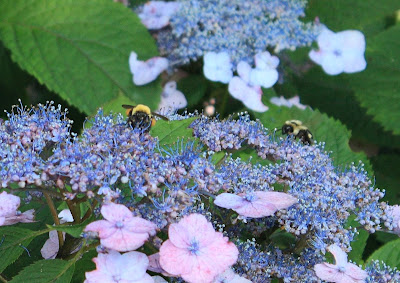
The rain may have taken a toll on our collective morale here in Northeast, but a weekend walk through the wilds of northwestern Manhattan convinced me that Ma Nature didn't mind the wet weather too much. It is incredible how the landscape of Fort Tryon has changed. The skies have (hopefully) cleared, revealing lush landscapes and burgeoning new blossoms. The pollinators, like us humans, seem elated at summer's belated glory in the park's unbelievably lovely Heather Garden. Below, two adorable bumblebees indulge in the sweet nectar of what seems to be wild hydrangea.


Honeybees, too, get in on the action. Note the pollen pants:


More pants! These girls are working hard!


The bumblebee (called "humblebee" in England... how quaint!) works alongside the honeybee in pollinating endeavors; this weekend, the hydrangeas seemed particularly appealing to both types of buzzers.

The complex relationships that exist in nature are innumerable. The bumblebee, however, happens to star in one of the most famous Darwinian examples of unlikely correlations: more bumblebees=more cats(!) The equation goes like this:

Bumblebees have long tongues. (Imagine a straw, rather than a human tongue.) Plus, they are fat. Their heft enables them to wiggle into the prudish red clover, while their long tongues extract the blossom's nectar.

The amount of red clover in an area depends on the number of bumblebees. Honeybees cannot pollinate red clover, as their bodies are not conducive to its shape, and their tongues are too short.

A favorite dish of the field mouse happens to be bumblebee comb, so the more bumblebee comb, the more field mice.

Feral cats love a good field mouse dinner, so where there are field mice, there are also cats.

To explicate summarily: Red clover depends on bumblebee pollination to survive, so where there is red clover, there are bumblebees; where there is bumblebee comb there are field mice, and where there are field mice, there are cats. Whoa!


I'm relieved to see that our city bees haven't starved to death because of the massive amounts of rain. Of course, my concern gives them little credit; they've been doing their thing for much longer than I've been doing mine. Still, the buzzing hydrangea shrubs ensure me, novice beekeeper and mere human, that Ma Nature knows what she's doing.

Wednesday, June 24, 2009

The Queen Must Die

I love the name of this book: at once dramatic, prescriptive, and poignant!


Spring and summer have formed a hybrid season, occurring now, that exhibits the worst qualities of each. Spring's freshness has withered in summer's humidity. Summer sunshine has been overshadowed by spring's warm rains and white skies. Thus, the following passage, describing early spring, is untimely. But I love it so much that I've peppered photos of early spring throughout, to lure the reader into reminiscing, if momentarily:

New colonies are usually started in the spring. It is important that [honeybees] build up quickly for the first honeyflow, that rich vernal harvest of early nectar, a time when nature herself is drunk with love and ecstasy, a time of alternate warm rains and cloudless skies, of flowering dogwood, locust, iris, shad, and earth.

The honeybee, released from winter bondage, revels in the renewed flowering of the earth, humming her own ode to joy.

And yet, over this exaltation, this climactic fulfillment of nature, hovers an explicable sadness that seems to have no place amidst such excitement of new life, as if it alone knows how soon all will vanish.
Any honey-lover knows that not all honey is created equal. Most honey found in supermarkets has been filtered so thoroughly that it barely resembles the original substance in looks or taste. Raw honey and honeycomb, my personal favorites, are pretty much untreated and provide a the honey-eater a richer, more satisfying gustatory experience.

Spring honey, usually harvested in May or June, is lighter due to the color of the nectar and pollen of early spring flowers. Summer honey, usually harvested in late August or September, is typically darker.

Summer introduces a whole new family of native wildflowers. If it ever stops raining for more than a day, the honeybees will meet this year's late-summer blooms, which start emerging in July. I can't wait to see what outrageous colors Ma Nature splashes across the city!

Tuesday, May 19, 2009

Cuckoo Bumblebees

Fort Tryon Park was abuzz with bumblebees today. I was lucky enough to catch this one on my camera. Look how adorable she is! She hovered noisily, then dipped down and squeezed her fat little self into a flower, gobbled up the nectar and pollen voraciously, then buzzed out, wiggled into another flower, and so on. When I realized that I didn't know much about bumblebees other than their cute factor, I figured this is information that a burgeoning beekeeper should know.

First of all, I thought they didn't sting. I realize now that I based this belief on my experience petting bumblebees, which is extensive (albeit extraordinary.) But they do sting, especially when they're defending their nest. The main difference between of bumblebees and honeybees is colony size; bumblebees usually have less than 50 members per colony, and we've all seen how many honeybees there can be. Plus, all except specially-created queens die before winter. The overwintering queens emerge in the spring and lay eggs conceived with the previous generation's drones. Honeybees, like humans, are forced to deal with the winter by mostly staying inside, eating, and cuddling together.
Bumblebees are skilled pollinators with funny names and cute little fuzzy stripes, so I love them too. Look at that gorgeous poppy pollen.... yum.Interestingly, there is a parasitic species of bumblebee called the Cuckoo bumblebee, who has lost the ability to collect pollen and thus support him/herself. There is no Queen Cuckoo. A female Cuckoo bumblebee will act like a normal bumblebee, foraging nectar and returning to the nest of the normal bees, an invader and impostor. Then, she enslaves the normal bumblebee queen and her entire colony, reproduces, and feeds the normal bees to her young. The Cuckoo Bumblebees have bigger sacks of venom and bigger mandibles, so there's really no defending yourself against the Cuckoos, if you're a bumblebee. The Cuckoo is the baddest bitch in the blossoms. Personally, I find it suspect that for the first few days of her insidious takeover plan, she feeds directly from the flowers. I mean, if she really wanted to she could just continue this practice, rather than brainwashing a bunch of other bees to do all her work for her and then eating them. It just seems a little over the top. For those of you who worry that my irreverently public insults about the Cuckoos will incite some kind of Cuckoo Assassination Mission against me, (and you know who you are,) don't worry. They are totally oblivious to humans and other mammals. Plus, I doubt they'd read a honeybee blog over a bumblebee blog, so I'm 90% safe.
Next time you see a cute little bumblebee waddling into a flower, ask yourself: Could this bee be Cuckoo? Or, could it be the slave bee of a Cuckoo master?
Although you can't see my shoes in the picture below, all of these photos were taken in bee camo. I could say that I didn't even realize it, but that'd be a lie. I did. What can I say? Bees make me happy.

Monday, May 18, 2009

The Beepot's Burden


My mother is one of the last Home Economics teachers in the country. Disappearing from school systems near and far, Home Ec is now called Family & Consumer Sciences, and now includes Sex Ed and Early Childhood Development. Mom's curriculum features detailed photos of real STDs, ("the kids are scared to death,") a life-like doll called "Baby Think It Over " that simulates infant behavior and records the number of times it is shaken, and of course, how to tell when your Crisco has gone rancid. (Smell it.)

It's really a shame that traditional Home Ec, sewing and cooking, is going the way of Wood Shop. Think of all those potential designers, chefs, and artisans that will never discover their callings. Or of those accountants, tax lawyers, and secretaries that could've lived a different lives, outside-the-box lives. Beekeeping certainly falls outside this box. I hadn't realized that "the box" existed at all, until I stood outside of it. Now that I realize that life outside is more interesting, more relaxing, and more whimsical than life inside, the idea of trying to hoist my weary self back into the overcrowded, ruthlessly judgmental, rush-rush-result box seems absurd.

A few weeks ago, my mom went on a teacher retreat to Old Sturbridge Village, Mass, a "living museum" of colonial New England. I went there for a 4th grade field trip. I remember thinking it was cool back then, but if I were to go today I'd be wearing bee-colored glasses, seeing the world through a lens of yellow and black. There must be a hive somewhere in Old Sturbridge Village. I mean, its supposedly a model of rural life at the turn of the 19th century and I would imagine (although I make no claims) that honey would be one of the only available sweeteners. If I could, I would watch colonial bees all day long, building their elaborate comb formations, spilling out of this tree or that outhouse, pollinating everything in sight. I wonder if they'd buzz differently, as if accented.

My mom didn't see any honeybees on her trip. Instead, she and her fellow teachers prepared a colonial-styled feast using the old methods of food preparation. They strung a whole chicken up above a roaring wood fire, and hung a big black pot beneath it to catch the fats and juices. They hand-mashed potatoes and churned butter. For dessert, they made a gingery, clove-scented spice cake and whipped fresh cream to put on top. The meal was delicious, according to my mom. And she's a Home Ec teacher, so she should know.

This past weekend my mom brought me a present she'd bought in the Old Sturbridge Village gift shop: a bee teapot! (Beepot?!?!?) How quaint!
Seems innocent enough, right?

Wrong. 20 years of maternal guilt brewed inside this teapot. According to my mother, before my school trip to Old Sturbridge Village she gave me money to buy something at the gift shop. I bought a beautiful geode and gave it to her. Now, my mom claims that she did not dislike the geode. However, in her thanks she reminded me that she'd given me the money to buy something for myself, as in, "You shouldn't have!" To my sensitive, 8-year-old ears, this sounded like rejection. Like, "Take your stupid rock, kid." I cried, she profusely apologized, and, unknown to me, carried this shameful burden for two decades. Until this teapot.

Truthfully, I don't remember the geode brouhaha. I was a mercurial child; my "episodes" blend together in memories. I tended to take every possible emotion to the Nth degree; happiness was elation, but sadness was tragedy. It doesn't surprise me that my mom remembered the geode, even though it had slipped into the annals of the past for me, probably between another forgotten geode and a chunk of wood from the Petrified Forest.
I do have one viscerally vivid maternal rejection memory. I went through an artistic phase in which I would scribble hard and circular in one color crayon, and call it a Monster. Although I was capable of drawing actual things, such as flowers and (admittedly distorted) people in my family, my Monster period was a time for me to redefine my conception of "art," much like the abstract expressionist artists. Today, I would describe my Monsters as Pollock-like in production. They required intense strength, and the kind of brutal concentration that is only achieved by sticking one's tongue out of one's mouth and biting it. My mom is not an Art teacher, and therefore did not recognize my unique creative perspective. I know this because I happened to be the same exact height as the garbage can, which shot open for just long enough for me to notice a stack of original Monsters partially obscured by dirty trash-things. I remember the shock that reverberated through my 5 year old body. I thought, This is the Picture Graveyard. Suddenly, I realized that the Monsters only accounted for a few of the fallen pictures. Dozens and dozens of other lovingly drawn pictures had met the same fate, never to be seen again. As I recalled the casualties, tears welled up in my eyes... they were gone and I could never get them back. Drawing them again, (mom's desperate suggestion,) just wasn't the same. I couldn't recreate the exact same Monster. They were one-of-a-kind, and they were gone.

I've never forgiven my mother. (JUST KIDDING MOM! Happy Belated April Fools/Mothers Day!!)

No, here's the truth: my mom is going to become my assistant beekeeper this summer! (Surprise again, mom!) My parents are letting me put some hives in their backyard in CT, and I pick up two 3-pound boxes of Italian honeybees in Massachusetts on Saturday! I'm looking forward to, among other things, 1) Naming my queens, 2) Comparing the city bees to the country bees and fabricating far flung, fanciful facts about city life and country life, 3) Painting my boxes purple and yellow (like pansies.) I've also decided to try some new things, which I'll elaborate upon when photographs of them materialize.

Here's an apt quote from Paul Bowles, one of my favorite authors:

One never took the time to savor the details; one said; another day, but always with the hidden knowledge that each day was unique and final, that there would never be a return, another time.

... and also that each Monster is unique unto itself.

Well, I added that last part myself.

In the meantime, I'll be preparing for my new bees, caring for the Spies and Secret Service, taking photos of things that tickle my fancy, and existing in my magical world outside the box.

Wednesday, April 29, 2009

The Unbearable Lightness of BEEing

Our bees won't make it up to Ft. Tryon; too far. (We've talked about tagging their tiny legs to track them, but it seemed too time consuming. Thoughts from anyone who has tagged the tiny legs of 5 lbs. of bees??) However, I did see some fantastic specimens of the honeybee sort gathering nectar from the myriad of colorful flora in the lovely Washington Heights. Anyone who says NYC is all concrete has another thing coming when they see these photos:

A Bonny View of the George Washington Bridge

The lush Hudson River Valley

Bumble Bee in Action

Loving Burst of a Cherry Tree

Checkered Tulip!

An unseasonably warm day in the city. I must check on the bees.
(And transplant the delicate plants onto the roof.)

When I arrived around 5:15 pm, the hive was abuzz with honeybees coated in sweet nectar. In the shot below, you can see the yellow pollen on the legs of the airborne bee in the middle. (His name is Mario.)

This is a great sign that the bees are beginning to forage out in big bad Brooklyn, despite the bee tea inside the hive and the delicious-looking clumpy marshmallow pile. (Although I caught two honeybees red-handed going for it in this photo!)

It was at this moment that I realized that I was in bee camo!

So I decided, "Why not just snuggle up for a bit?"
They felt it too.

By 7, bees were flying back to the roof from every direction. I'm sure some even made it to Manhattan and Queens. (Hopefully not Staten Island. They're smart little dudes.)