Showing posts with label honeybees. Show all posts

Monday, November 2, 2009

I Heart Sun


Daylight Savings is over. In November, we "fall back" to Standard Time. We wake in darkness. In less than two months, most New Yorkers will return home from work in darkness, as well. The term "Standard" proclaims "This Is The Way It Is Supposed To Be."


This seems like one of those things that we humans impose upon ourselves for no reason, just to make our lives more difficult. (Or to satisfy somebody's secret agenda. I suspect Cheney.)

Why can't we accept that 6am in July just feels different than 6am in January? Instead, we've got to go messing with our parameters of conceptualization and all that jazz. Why must we torture ourselves with such major structural shifts in time, altering the way light-- we're talking about the SUN-- we're talking about the BIGGEST, most POWERFUL ball of FIRE in our UNIVERSE-- affects us, on such a regular basis?


A honeybee always follows light, wholeheartedly believing in the sun's ability to sustain. If a bee finds herself trapped in a glass bottle, she will likely die there, thrashing her body against the glass toward the light instead of toward the opening in the top. The bee does not abide by the logic discovered (or created) by humans. Does this make her stupider than the ugly fly, who dizzily, clumsily, ascents to freedom?


I think not.

Tuesday, October 6, 2009

Massacre of the Drones


A male drone is distinguished from a female worker bee by his bulky stature and big, dumb eyes. Compared to the girl-powered majority, he's a few crayons short of a pack. He rarely leaves the hive, gets drunk on honey he had no part in cultivating, is all but immobile and almost completely blind. Some suitor.


Around this time of year, when the temperature starts to drop and the trees start blushing, the worker bees begin a thorough decimation as methodical as it is just:

"There is, at first, no sign of menace, although the drone's worker sisters have grown increasingly testy as the nectar supply tapered off with the end of summer. The drone is, as usual, swaggering across the combs, shoving aside workers who get in his way as he heads toward the capsules of honey. But this time something is wrong. A couple of females block his path. The big fellow is surprised by this unexpected resistance. "What's going on here?" his manner says. The workers do not yield before him. Then, both females suddenly fall upon the startled drone, pummeling him, biting his fine wings, tearing at his antenna and legs, violating his macho male superiority. The carnage is underway." -The Queen Must Die, by William Longgood

The carnage is certainly underway in my hives. Drone bodies litter the ground, their googly eyes seeming to implore a desperate "WHY?" in their inertia. The air is crisp, and although the sun still beams down upon the Northeast, the workers know that winter is fast approaching. The drones, bumbling bags of sperm that they are, are no longer of use to the colony. Uselessness in a beehive is a crime punishable by death.

The massacre of the drones marks an important seasonal shift. Bountiful summer has passed, making way for autumn's last harvest before cold, dead winter stifles out all but the most hardy, adaptable life.

I've been mourning the passing of summer, the season that finds me at my happiest and most energetic, in a quiet way. After celebrating the magic of the living seasons, I now turn my attention to fall and impending winter, seasons that embody loss, death, and silence. (Do I sound too morose? Good.)
The sun has begun to sink low in the sky, casting a golden nostalgia upon every surface it touches. The shade, once an ally, has grown tired of being sought after constantly, and begins to welcome wind and dampness to its dark corners, in an attempt to fend off unwanted guests. The worker bees have begun enacting brutal revenge on their lazy brothers. The sun, the shade, the drones... the first to go in a long, long line of loss awaiting us.
Autumn is a season of change. Things are changing. What is most important, now, is to remember each day for what it is. Soon, it will lie beneath soft sheets of frost, and only memory, and love, will keep it warm.

Wednesday, September 2, 2009

Royal Jelly


One day in the Mekong Delta in Vietnam, a vendor extolled the virtues of royal jelly, the substance created by honeybees to feed their queen, to a glamorous Italian woman. My sister, incogneets, of course, watched as he demonstrated the topical application on his own face, likened royal jelly to the fountain of youth, and promised that regular use of the substance would erase years from the Italian woman's life. The vendor had found his target population for sure: foreign, with money to spend, and deeply concerned about wrinkles.

Royal jelly has been touted as a miracle substance for centuries. I've often wondered how, back in the day, anyone thought that a cactus might be edible. I feel the same way about royal jelly-- who came up with this idea of bee food as topical cream? I imagine some wacky Ancient Egyptian beekeeper discovering the queen's special stash of R.J. in the hive and smearing it all over her face. Why? We'll never know. But something stuck, because royal jelly is hawked worldwide as a miracle, from Burt's Bees products to vendors in the Mekong Delta.

Personally, it seems a bit too precious of an idea to be true: only food fit for a queen contains the secret of youth, blah blah blah. As I've mentioned many times before, the queen ain't all that. She's a baby-making machine, so her food must be pretty nourishing, but it still doesn't follow that it makes sense to smear it on the outside of one's body. Conceptually, perhaps. A conception that, like so many, falls apart in reality.


The seller had an answer for haters like me: "You can eat it too!" he explained of the 2 oz. bottle of royal jelly that cost more than the aggregate costs of my sister's six month journey through Southeast Asia. Although theoretically, eating royal jelly makes more sense to me in terms of deriving health benefits, it seems strangely naive to liken the nutritional needs of a queen bee to those of an adult human. In "Royal Jelly" by Ronald Dahl, a father forcefully feeds his underweight newborn royal jelly. (It is an incredibly creepy, yet strangely informational short story that is highly recommended reading.) The father explains to his wife:

"Practically nobody in the world can afford to buy royal jelly just for eating except maybe one or two multimillionaires. The people who buy it are the ones who make women's face creams and things like that. They're using it as a stunt. They mix a tiny pinch of it into a big jar of face cream and it's selling like hot cakes for absolutely enormous prices. They claim it takes out the wrinkles."

We are obsessed with youth! Why youth? What I mean is, why is youth so cherished, why is aging so desperately feared? Fine, aesthetics. Health. But we tend to collectively forget most of the unsexy aspects of youth, like having to go to bed at specific times, having to eat things we didn't like, puberty, braces and, later on, being broke. Plus, is there no beauty in a lined face?

All worker bees follow the same lifeline. They begin their lives as nurse bees, then become builders, architects, until finally they become foragers. Bees must go through a training period before foraging. During this period they practice flying short distances, presumably learn the waggle dance, build up their wing strength, you know, normal bee stuff. You can tell which ones are foragers-in-training outside the hive: they're the tentative little dudes (gender neutral, because all foragers are necessarily female) making circles that grow over time.


Foraging, in my opinion, is the best part for honeybees, a pleasure afforded only to the oldest folks in the hive. They get to go explore all the flowers in the hood! Healthy honeybees will forage until their bodies wear out: tattered wings, limbs missing, cockeyed, perhaps. Hopefully they die in the fields among the flowers. Otherwise they'll be carried out by their sisters and deposited as far away from the hive as possible. (Honeybees are impeccably tidy.)


Bees got it right, in my opinion: save the best for last. Imagine if we were constantly looking ahead, waiting for wisdom. We'd be excited by wrinkles and balding. We'd write songs called "Forever Old." Retirement would be like spring break in Cancun.

I might eat royal jelly if, and this is a big if, I realize, somebody convinced me that by eating it I would become a bee, like in Dahl's story, but only for one day and not in the winter. Imagine the secrets that would be revealed to me! Who is behind the hive mind?!?


The same sister, plagued with unquenchable wanderlust, loves this quote from Barbara Kingsolver's The Poisonwood Bible,and I believe it is an apt way to wrap up this rambling post:

"To live is to be marked. To live is to change, to acquire the words of a story, and that is the only celebration we mortals really know. In perfect stillness, frankly, I've only found sorrow."


I don't want to be obsessed with youth when I am old. I want to enjoy it now, live it, use it, celebrate it. But when it's gone, and I'm not sure that it ever really leaves, I will look in the mirror at a face marked with change, and hopefully I will smile with the knowledge that I really, truly lived the life I'd imagined.

Tuesday, August 25, 2009

How to Defeat the Evils of Nepotism

As you've probably noticed, I'm quite fond of comparing honeybees to humans. We both exist in complex social systems that aim to sustain us. We both love honey. We humans love to name things. (Do honeybees have names for us? Perhaps certain buzz frequencies that signify "human?") We distinguish between individual things and the groups in which they congregate. A colony of bees. A gaggle of geese. A parliament of owls. An army of frogs. A knot of toads. (The list goes on...)


But what of ourselves?? A family of humans? A culture of humans? A society of humans? We map family trees based on sexual relations that produce babies. Is this the only way to distinguish our kin?

The family tree of a honeybee colony would resemble a thick, round shrub more than a towering oak: a drone might be his mother's lover. Although the prolific deadbeat dad has challenged the patriarchal system of organization, most women in America still change their last names upon marriage to signify membership in a new system of kinship. The idea of family is defined in this way: the Griffins, the McChards, the Plakiai...

The queen bee's mating flight lasts for two to three days and intimately involves between 10 and 25 drones, depending on her penchant for doing the nasty. This rowdy sexcapade is productive enough for the queen to never mate again. She carries the sperm inside of her, and deposits sperm and egg in a honeycomb cell to create a female worker bee, and egg alone to create a male drone. She will continue depositing egg and sperm into honeycomb cells unceasingly for the remainder of her life.


In the bee world, if a mother queen dies unexpectedly, worker bees will feed royal jelly to a handful of larvae. Imagine you are a female worker bee. Your mom just died and you must replace her. You are in charge of choosing the cells in which you will deposit royal jelly. Cell A contains the larvae of some random chick. Cell B contains the larvae of your sister. Interestingly, entomologists have noted that you will almost always choose your sister's larvae. Bees are nepotists!


Natural selection does trump nepotism. Remember that you must feed royal jelly to more than one larval bee. When the virgin queens emerge, they duke it out to the death, and the last one standing becomes royalty.

Nepotism is, therefore, a natural-enough tendency. But I've got problems with it. When I was in middle school, I was a "bad influence." Or so it seemed to the mothers of my female friends. In reality, I was incredibly unhappy, as most teenagers tend to be, and did not need to be excommunicated from my only friends by overprotective moms. (Seriously, if I didn't peer pressure your daughter into smoking weed, somebody else would've. And that somebody might have been a scary old man instead of sweet little me.)

Of course moms are protective of their kids, but calling a 13-year-old on the phone and forbidding her to speak to, let alone be friends with, her daughter is just plain cruel. I'm not the only bad influence to have this happen, either. The result of the mother bee's overreaction is a super-strong, super-small kinship system that excludes anyone who doesn't share a last name.

Does this mean that it is wrong for the worker bee to choose her sister to become queen? Well, this is the point at which my argument falls apart.

We 'Mericans tend to like our circles close-knit, uniform, and exclusive. But kinship need not be familial. When like-minded, inspired individuals work together to create a supportive, productive community, a new kind of family is born. Like a honeybee colony, each individual is important only insofar as she is part of a whole.


When people work together toward a common goal that is both satisfying and fruitful, something magical happens.


We're no longer alone in this confusing world!


In this way, life bursts forth from concrete, life free from nepotism.


At Added Value, when we harvest, cook, and eat meals on the farm together, we say this blessing:

We thank the sun and the air,


the water and the soil,


the many hands it took to grow this food,


and the many hands it took to prepare it.


I love my many families.

Tuesday, August 11, 2009

How To Harvest Honey: City Edition

1. Go to a beautiful Brooklyn rooftop beehive around noon, when the sun is high. Bees do not like being disturbed when they sense a chance of rain, and of course don't like having their honey stolen. This gloomy Sunday morning, atop a brownstone in Ft. Greene with affable veteran beekeeper John Howe, was incredibly humid for sticky honey extraction.
2. Make sure your bees have survived one winter before attempting to extract honey! This beekeeper decided to only extract from his stronger hive this summer. June's endless rain was a tough hit!
3. Instead of smoking the bees, which can irritate them after they've emerged from confused stupor, this beekeeper sprayed a fume board with this stuff and put it in the honey super. It smells a lot like bitter almonds. The bees hate the smell and leave the honey super.
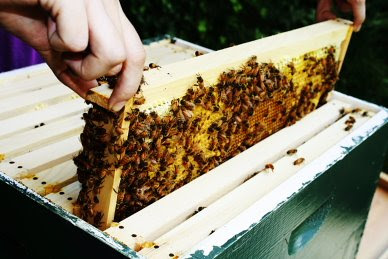
4. Pry the honey-heavy frames from the super. Look at all that excess comb on top! There's a reason they're called busy bees.
5. Remove each frame slowly and deliberately. Be present 100%.
6. Marvel at the intricate craftsmanship of the honeybee, who has capped each hexagonal cell of honey with beeswax.
7. Remove the frames, close the hives, and take the frames to the "honey room." (Climb through roof hatch and down ladder... helping hands highly advisable.) Slice the wax cappings off with a hot knife, releasing the honey and catching it through a strainer.
8. This metal thing is an extractor. It works by spinning four honey-rich frames with a hand crank and catching the sweet, sticky nectar as energy sucks it out of the cells, leaving them shell-like and empty. They will be replaced in the hive this way, so that bees don't need to rebuild the comb from scratch.
9. Pour the caught honey into yet another strainer.
10. Stick your finger beneath a drop, savor it, and bid your fellow beekeepers goodbye!


Friday, July 31, 2009

Three Bee Salad

Many people can't distinguish between honeybees, bumblebees, and yellow jackets. It's a bummer for the bees, because yellow jackets are nasty little things. Bees-- honey, bumble or otherwise-- are, on the other hand, fuzzy, cute, and hardworking.

The honeybee, seen below, collects pollen from flowers for honey. The chubby bumblebee also collects flower nectar for honey, although she produces far less than her petite cousin. Do the bees inadvertently pollinate? Or do they have a deal worked out with the flowers?
The yellow jacket, sleek, hairless, and yellow-faced, is a predator. She lives in a dusty nest made from wood, not wax. She will happily eat the rest of last week's pulled pork sandwich from the dumpster. No flowers for this girl.

After the Michael Jackson incident, I take pride in the fact that every single photo on this blog (except the humping bees) was taken by my trusty Canon. In an attempt to remain in this same vein, I tried and failed to capture a yellow jacket in action on my camera. Those suckers are quick! Instead, I created my own picture of a yellow jacket on stray cardboard (to represent garbage,) using my yellow and black nail polishes:
As you can obviously see from this anatomically and politically correct diagram, yellow jackets are more yellow than honeybees, and at least this one bumblebee. (Many bumblebees are more yellowy than this one.) They have these creepy, dangly, yellow legs that create the impression of a skulking hunter.

Yellow jackets are aggressive, and their sting registers a 2.0 on the sting scale, described as "W.C. Fields extinguishing a cigar on your tongue." Most people who have been stung by a yellow-and-black insect have most likely been stung by a yellow jacket. So back off the bees!


Tuesday, July 14, 2009

The Incredible Grossness of Life

Dana and I went into the hives yesterday to check things out and add a super (box sans bottom) to the hive. I started with Shera's hive; everything looked good in the hood. I moved to Catra's hive, using my hive tool to pry open the propolis-glued cover. Things looked quite busy, even for a bee. Dana held the surrounding frames down as I pried a fat one out of its waxy thicket. The bees had constructed a wax bridge between the frame in my hand and the one in the box. Apparently, the queen had laid eggs in the bridge. My hand had twisted the bridge in two, releasing two white, slimy, slug-like beings that are called bee larvae from their cells, prematurely. Bee larva in action is gross. They squirm and squiggle and look so exposed next to the worker bees. But that's their destiny. So weird.

"Dana, take a picture of this, this is gross. For the blog and to document it. Actually, this is really gross. Never mind, nobody wants to see this. Ew, this is disgusting, I don't want to see this."

That was my thought process, or what I tried to get across in words, most likely more convoluted, fragmented words, to Dana, armed with my camera.

Queen bees lay eggs in honeycomb cells. Eggs become larvae. Larvae become pupae, or, soft, white bee skeletons with sinister eyes. Pupae become bees, which push their way out of the cells as the fuzzy little buzzers we all love.

I shoved the larvae frame back in place and moved on to a frame at the other end of the super to the site of the potential supercedure cells. Well, it turned out that these weren't supercedure cells; rather, they were either worker or drone cells. Supercedure cells would be much more peanut-like than these cells. Most excitingly, we witnessed the "birth" of a bee: see the little (leg? antenna?) sticking out of the cell? It was just feeling its way into this intricately bizarre world of ours, of honeybees, all animals...

A new friend helps her out.

She pushes herself into the world.

Welcome to our world, small bee.

Hive-Mind: The Man Behind the Curtain


Anthropomorphism is considered by many great minds to be self-indulgent, suggesting departure from truth and marking the human tendency to sentimentalize. But answer me this: how can we attempt to understand animal experience without framing it, in some meaningful way, with human experience?

Dog days of summer finally upon us here in NYC, honeybee colonies are at their strongest in number. The new, spring hive has housed a handful of generations of bees already, and the current inhabitants continue to work for a future that they'll never see.


Each pair of pollen pants tells a story. A fearless forager bumbles home, weighed down by the heavy pants, and waddles inside where her sisters take a load off Sally. The pollen pants will be transferred from Sally's legs to those famous hexagons that all bee fans know and love. Scientists originally thought that long ago, bees evolved by learning to build tiny hexagons when their non-hexagonal cells naturally smooshed into the six-sided cubbies. Now, it seems that the hexagons have always existed; in other words, Ma Nature imbued honeybees with the ability to build these fascinatingly precise wax cells at their very creation.

Who is the man behind the curtain? Who pulls the levers and pushes the buttons?


The Wizard of Oz builds a fantastical world upon an illusion of power. The queen bee (named anthropomorphically... you're busted, scientists...) exerts a similar illusion of power over her human fanatics. We love the Queen Bee... she's a fine-assed woman who won't take nothin from no one. She rules the roost with sass and class, right?

Wrong. The queen bee is more bumbling man behind the curtain than great and powerful wizard. Come on, Sir Francis Bacon and other haters, if you want to criticize anthropomorphism then don't call her Queen Bee in the science books. You might give people the wrong idea.

Although it is unclear who makes the decisions in a colony, meticulous observation suggests that decisions are reached by consensus in the honeybee world. All elections must eventually resolve themselves unanimously. Does one, sole honeybee organize it all? Does this honeybee pass down her role as hive-mind to a future sister by filling a single brood cell with knowledge? Only Ma Nature knows, and she's pretty tight-lipped.

Human cannot master bee. Within their ordered, efficient, just yet ruthless world, the hive-mind of the honeybee is as unpredictable as human history. How can't we anthropomorphize when speaking of honeybees? We're all just lonely animals trying to understand our own finite existences. The honeybee's short yet harried life gives us small, hexagon-shaped glimpses into our own small places in this widening gyre of consciousness.


Friday, July 10, 2009

Royal Races: Bees vs. Humans

My kid sis and future beekeeper Dana had alerted me to the possibility of supercedure cells in the hive, so I had to inspect. Supercedure cells look like wax peanut shells protruding from the comb; the colony is creating new virgin queens. The presence of supercedure cells in a hive typically means one of two things: they will replace the existing queen with the virgin queen by suffocating her in a tight ball of buzzing bees because they're in some vital way unhappy with her, or the existing queen and up to 3/4 or the colony are preparing to swarm, leaving behind progeny to continue the family line. This is unlikely, as swarm season has passed, although that hasn't stopped countless colonies from deserting their honey-filled homes to starve in a barren winter tree. Bees, like humans, can be self-destructive and don't always act in their actual self-interest.

I smoked the bees; just a puff here and there to confuse the guard bees on the hive landing and mysteriously soothe the colony. Yum.


Free to Be You... And Me, a 1970 film for kids, was a fan favorite among my sisters and I. Marlo Thomas, who is my shero, wrote songs and skits for public figures to sing and perform, about topics like love, sadness, sexuality, and freedom, to name a few. One features a really young Michael Jackson and Roberta Flack singing about growing up... do yourself a favor and watch it.


Anyway, Free to Be... You And Me might be worthy of an entire post, its so fantastic. But I digress...


One skit features a very fast princess named Atalanta, who doesn't want to marry just because that's what girls do, (you go girl!) to her father's cantankerous chagrin. Atalanta races all of the town's men, agreeing to either marry the winner or win and choose. It all comes down to worried Young John and Atalanta... after much suspense (and huffing and puffing,) they cross the finish line at the exact same moment.


The queen's mating flight is much like this skit. After days of training, lecherous drones dazedly passing the virgin queen in the hive, without lust or second thought, the queen releases a pheromone that says "I'm ready" and shoots into the air, emitting a shill chirp, until hundreds of drones from hives near and far race to catch up to her. Eventually, weak suitors fall behind until one single drone, the strongest, remains.

In Free To Be... You And Me, instead of joining together in union, the princess travels the world on her horse and her suitor becomes a great scientist- and the story ends with the possibility of a love reconnection after they'd followed their respective dreams, but assures the viewer that another ending wouldn't make the story any less significant.

In the bee world, the queen and the winning drone do join in union. In fact, their union is so strong that the drone's sex organs are ripped off to remain in the queen's body as he falls to earth with intestines dangling from serrated abdomen. When she returns to the hive, her attendants remove the drone's bottom-half from the queen's bottom-half. She'll get her kicks for 2-3 days, return to the hive, and never mate again.


In Free To Be... You And Me, Alan Alda and Marlo Thomas narrate. There is no narrator in the bee's story, but if there were, it would be Werner Herzog. He would contrast the queen's sexual burden with the workers' sexual disenfranchisement. He would continue to use the word "increezingly." He would empathize with queen and drone, slaves to their hard working sisters and daughters.

Atalanta is only a princess, but she enjoys the right to choose, a right that separates us from insects and other species that are bound to the ball-and-chain of instinct and dragged, or perhaps exalted, through life by a mysterious plan devised by Ma Nature that humans simply cannot decipher. The queen bee is a queen in name only, her nomenclature more parody than analogy.

Princess Atalanta is sovereign, and her suitors probably envy her power or are delighted by the idea of her. Queen bees are peons, held captive by their base ability to procreate. They are owned exclusively by their daughters, who nevertheless care for their mother meticulously. (Did anyone ever read Lois Lowry's The Giver in high school? Think of the birthmothers: held in low opinion, yet essential and thus pampered.)


My queens, Catra and Shera, look big and healthy, but one of them may be a marked woman. Although both of them are actually marked with a green dot, only Shera seems to be potentially marked for assassination. I cannot determine whether or not what I see are supercedure cells. If they are, I hope they do not swarm. It may sound cruel, but I hope they're planning on assassinating Shera. Not because I like a good cat fight, because I don't, and happen to despise the phrase "cat fight" at that, but because its a natural phenomenon that requires no beekeeper action and actually serves the self-interest of the colony. Otherwise, I might have to climb a telephone pole with a bee vacuum, and I'm not feeling too dexterous.

Do you think she knows??