Showing posts with label red hook. Show all posts

Saturday, September 19, 2009

The Boat Parade


In September 1609, a sailing Dutchman named Henry Hudson happened upon the eponymous Hudson River. It was a beautiful day, all blue skies and warm breezes.


By the time Hudson's crew rolled in, they were cold and mutinous... they'd just tried and failed to forge a route through what is essentially the North Pole. (Sadly, this route is now navigable due to climate change.)


The crew set up camp on an island the local Lenape tribe called Mannahatta, "island of many hills." (The Lenape had obviously never seen San Francisco.)


On a warm day in September, my own crew set sail on the Clearwater, a gorgeous old sailboat with a mast constructed from a single tall tree. The idea for the Clearwater was conceived by folk legend Pete Seeger and built in 1969. Today, it has a vast wooden deck, a kickass educational program, and a slew of passionate interns and volunteers.


The Clearwater composts all of their food waste at the awesome composting operation at Red Hook Community Farm. Who says nonprofits can't network with the best of 'em?


My crew and I arrived at the dock behind the Red Hook Fairway at 09:00. After a group effort to hoist up the sail, we proceeded through the Buttermilk Channel to the Battery Harbor for-- and I'm not kidding-- a boat parade for the prince of the Netherlands.

I imagine the prince in his castle declaring his desire for a full-on flotilla in NYC. "Your wish is my command, sire," his loyal servant would pronounce.

We wondered aloud: what if the prince was 3 years old and had a poopy diaper? Did he wear a crown? Was he single?

The Clearwater got in formation behind old-looking boats with whimsical names like The Peacemaker.


The prince's boat was a ginormous... we thought we spotted him in a pink tie for a fleeting moment, but machine guns (see below) deterred us from hoisting ourselves into the water and throwing ourselves at his feet like teenaged Jonas Brothers fans. Instead, we did the wave. Classy.


We proceeded to sail in incredibly close quarters around the harbor. It was more than evident that the real crew was stressed by the proximity certain unruly boats. Many flotilla vessels had either sailed from Holland or stuck their boats in containers and shipped them to New York. The small ships below are called Flying Dutchmen, which seemed enough to warrant their participation in the Dutch celebration.


It is easy to forget that this crazy city is, at its heart, a maritime wonderland. Until you take to the water, that is. Reality check 101.
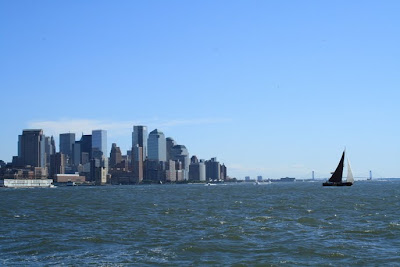

The Clearwater aims to illuminate this fact. Getting to experience the city from the water provides the passenger a privileged view of the importance of healthy waterways.


If this isn't a privileged view, I don't know what is.


The Clearwater accepts volunteer educators, apprentices, and crew to join its ranks, and frequently opens itself up for public sails!

*The Supreme Court decided that streams and wetlands are exempt from protection from the Clean Water Act. Sign the petition to advocate for change! Streams and wetlands may not be grandiose as lakes and rivers, but they're just as important for a healthy ecosystem!

Thursday, August 27, 2009

Two Bridges

Brooklyn, New York


The Gatsby-esque Brooklyn Bridge is gothically grandiose, its masonry as imposingly human as the lives lost during its construction and the dreams it represented. Completed in 1883, the idea of spanning the East River between City Hall in Manhattan and Brooklyn, not considered a borough of NYC until 1898, had been considered as harebrained as they come. I mean, Brooklyn was called a "Twin City" to Manhattan in the famous Emma Lazarus poem on the Statue of Liberty, so it wasn't a matter of noble savages or anything, but that river was big, dude.


Most people at the time(unschooled as most of as are in matters of advanced engineering,) didn't believe it could be done. "Poppycock," a proper Englishman might call the endeavor. Instead, all the laypersons watched as the massive bridge was erected. (haha.)


Of course, back in the the 1880's they had ferries. Imagine what it was like in the 1650's when the land was mostly used for agriculture, and you had to rowboat across the East River. These days, I cross from Manhattan to Brooklyn and back again like it's nobody's business, without a care in the world about strong currents or wolves kickin' around.


Manhattanies and Brooklynites back in the day (also known as the Lenape tribe) were river people, farming maize and burning crops 'cause they knew it was good. I'd like to have been alive at this time, chillin' in what's now Red Hook in a marshy inlet, fishin'. I'd like to be both a wise, elderly grandma and a fifteen-year-old boy. (I figure if I shoot for both wisdom and innocence in my fantastical vision of myself as a Lenape Indian, when I finally do time-travel I'll be 50% more likely to arrive at my destination in a consciousness with the best traits on both ends of the age spectrum.)


The Brooklyn Bridge is so historically majestic that just being in its presence lends a certain gravity to the moment.


The Manhattan Bridge, on the other hand, is a utilitarian's dream.


Its efficient subway lines and hospital-aqua paint job are wrought with the steely will of the Industrial Revolution or an Ayn Rand novel.


No, the Manhattan Bridge wasn't a first. It isn't a beauty. It breaks no records. It most likely figures less prominently in photographs than other city landmarks.


How would it feel to forever compare unfavorably to one's neighbor? At least people are mobile.

Tuesday, August 25, 2009

How to Defeat the Evils of Nepotism

As you've probably noticed, I'm quite fond of comparing honeybees to humans. We both exist in complex social systems that aim to sustain us. We both love honey. We humans love to name things. (Do honeybees have names for us? Perhaps certain buzz frequencies that signify "human?") We distinguish between individual things and the groups in which they congregate. A colony of bees. A gaggle of geese. A parliament of owls. An army of frogs. A knot of toads. (The list goes on...)


But what of ourselves?? A family of humans? A culture of humans? A society of humans? We map family trees based on sexual relations that produce babies. Is this the only way to distinguish our kin?

The family tree of a honeybee colony would resemble a thick, round shrub more than a towering oak: a drone might be his mother's lover. Although the prolific deadbeat dad has challenged the patriarchal system of organization, most women in America still change their last names upon marriage to signify membership in a new system of kinship. The idea of family is defined in this way: the Griffins, the McChards, the Plakiai...

The queen bee's mating flight lasts for two to three days and intimately involves between 10 and 25 drones, depending on her penchant for doing the nasty. This rowdy sexcapade is productive enough for the queen to never mate again. She carries the sperm inside of her, and deposits sperm and egg in a honeycomb cell to create a female worker bee, and egg alone to create a male drone. She will continue depositing egg and sperm into honeycomb cells unceasingly for the remainder of her life.


In the bee world, if a mother queen dies unexpectedly, worker bees will feed royal jelly to a handful of larvae. Imagine you are a female worker bee. Your mom just died and you must replace her. You are in charge of choosing the cells in which you will deposit royal jelly. Cell A contains the larvae of some random chick. Cell B contains the larvae of your sister. Interestingly, entomologists have noted that you will almost always choose your sister's larvae. Bees are nepotists!


Natural selection does trump nepotism. Remember that you must feed royal jelly to more than one larval bee. When the virgin queens emerge, they duke it out to the death, and the last one standing becomes royalty.

Nepotism is, therefore, a natural-enough tendency. But I've got problems with it. When I was in middle school, I was a "bad influence." Or so it seemed to the mothers of my female friends. In reality, I was incredibly unhappy, as most teenagers tend to be, and did not need to be excommunicated from my only friends by overprotective moms. (Seriously, if I didn't peer pressure your daughter into smoking weed, somebody else would've. And that somebody might have been a scary old man instead of sweet little me.)

Of course moms are protective of their kids, but calling a 13-year-old on the phone and forbidding her to speak to, let alone be friends with, her daughter is just plain cruel. I'm not the only bad influence to have this happen, either. The result of the mother bee's overreaction is a super-strong, super-small kinship system that excludes anyone who doesn't share a last name.

Does this mean that it is wrong for the worker bee to choose her sister to become queen? Well, this is the point at which my argument falls apart.

We 'Mericans tend to like our circles close-knit, uniform, and exclusive. But kinship need not be familial. When like-minded, inspired individuals work together to create a supportive, productive community, a new kind of family is born. Like a honeybee colony, each individual is important only insofar as she is part of a whole.


When people work together toward a common goal that is both satisfying and fruitful, something magical happens.


We're no longer alone in this confusing world!


In this way, life bursts forth from concrete, life free from nepotism.


At Added Value, when we harvest, cook, and eat meals on the farm together, we say this blessing:

We thank the sun and the air,


the water and the soil,


the many hands it took to grow this food,


and the many hands it took to prepare it.


I love my many families.

Sunday, August 23, 2009

Ode to New York City Summers


Even though your humid skies sag like wet diapers, I love you, New York City summertime. Thick, lukewarm air spits through the fan in my uptown apartment, mocking the archaic mechanism. Existence alone is cause for perspiration. Lady Liberty exemplifies the obstinate disregard for sweat that we New Yorkers must adopt.


I believe your subways are more conducive to men in heavy wool business suits than urban farmers in cutoffs and tank tops; they blast sterile bursts of cold air through loud AC systems and force me into the fetal position. (Although I must admit, your icy embrace has prevented me from waking up in the Bronx or Queens on several occasions.)


Girls have never been prettier than they are when they are walking down your streets in August drinking 40s in coffee cups.


Your expansiveness is overwhelming. Your opportunities are so numerous that they inspire guilt in those who fail to take full advantage of them.


Your summers illuminate little-known details that would be hastily ignored in meaner weather.


There's nothing like drinking a cold, locally-brewed beer on your Red Hook roof deck, New York. It can be a mystical experience.


View of you from Governor's Island:


View of you from Queens:


View of you from inside:


You're beautiful, New York City, no buts about it!


The reason I love you the most, though, is because you are a grown-up playground that brings friends together.